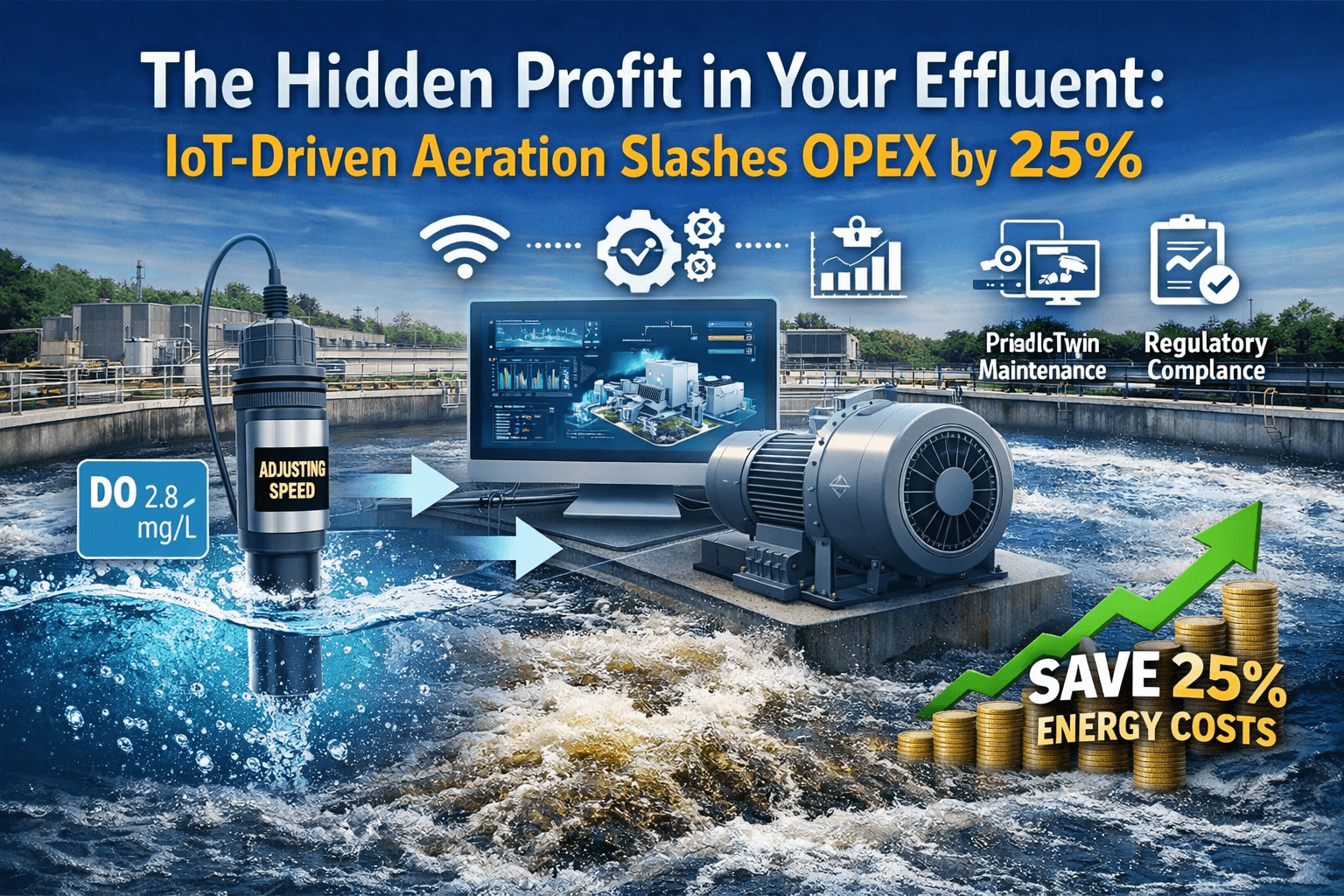
For most industrial and municipal wastewater treatment plants, the aeration process is a necessary “energy hog.” In fact, aeration typically accounts for the largest single share of a facility’s electricity bill.
The problem? Most traditional systems are “blind.” They run blowers and compressors at constant speeds, regardless of whether the organic load is high or low. This leads to massive over-aeration and wasted capital.
The Shift to Dynamic Control
The solution lies in the integration of Industrial IoT (IIoT) and SCADA systems. By deploying real-time sensors to monitor parameters like Dissolved Oxygen (DO), facilities can transition from static operations to intelligent, dynamic control.
How it works:
- Real-Time Sensing : DO sensors detect the exact oxygen requirement of the biological load.
- Instantaneous Modulation : The IoT controller signals the Variable Frequency Drives (VFDs) to adjust blower speeds immediately.
- Precision Delivery : Oxygen is matched to demand, preventing energy waste during low-load periods.
Beyond Energy: The Financial Case
While a 25% reduction in aeration energy costs is the headline, the financial benefits extend further:
- Predictive Maintenance: IoT systems monitor the vibration and temperature of pumps, identifying failures before they lead to costly downtime.
- Digital Twins: Historical data allows for the creation of process simulations to refine long-term efficiency.
- Regulatory Synergy: Most facilities are already investing in IoT for CPCB OCEMS compliance. By using that same infrastructure for aeration control, you turn a regulatory necessity into a high-ROI financial optimizer.
Is your facility still running on “static” mode? Our team can help you analyze your current DO levels.